
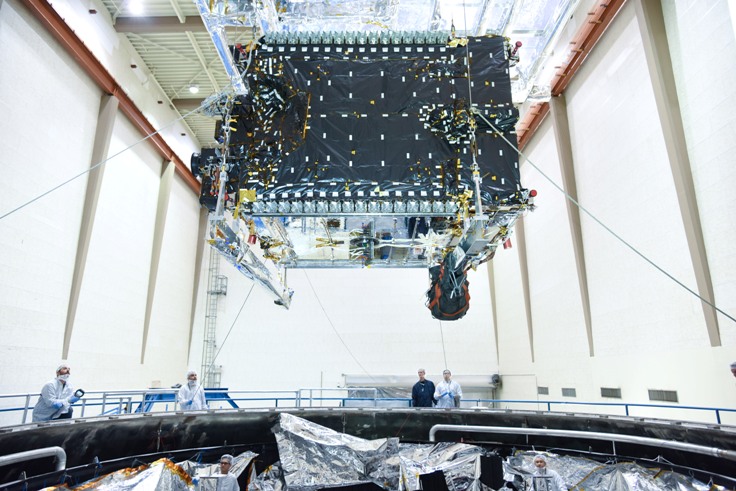

SOFIA (Bulgaria), April 17, 2016 – The first Bulgarian communications satellite BulgariaSat-1 was lowered last week into a large chamber, known as a thermal vacuum chamber, and began testing in an environment designed to simulate the harsh conditions of space.
This is a key milestone in the process, which comes two years after Bulstacom began producing the satellite and preparing for the launch of Bulgaria Sat-1.
The chamber will heat the satellite to up to 80 °C and cool it to as low as -70 °C in a high vacuum. Because there is no atmosphere at the location where the satellite will operate, at 36000 km above earth, heat is not conducted like it is on earth, so the side facing the sun will be exposed to extreme heat, and the side in shadow will be in the cold of deep space.
The satellite will be tested extensively under these conditions to ensure that the radio-frequency components function properly in extreme environments. BulgariaSat-1 will remain in thermal-vacuum testing for about a month before moving on to further assembly and testing.
"Bulgaria Sat-1 testing in the thermal vacuum chamber is one of the most critical moments of the manufacturing of any spacecraft. This is an extremely exciting time for all the professionals at Bulgaria Sat. We are ready for the next test on our path to this mission in space."
The next step is testing the satellite antennas at the Compact Antenna Test Range (CATR), planned for July 2016. Only when the satellite has demonstrated flawless performance after all testing will it be delivered to the launch site on board an Antonov-124-100, the world's largest civil cargo aircraft, operated by the Russian Volga-Dnepr Group.
The satellite's manufacturing was awarded to the leading company in this field, Space Systems/Loral (SSL), based in Silicon Valley, United States. There is significant progress in the construction and testing of the first Bulgarian communications satellite, giving every prospect that BulgariaSat-1 will be ready for delivery and launch on a SpaceX Falcon 9 rocket later this year, with the launch broadcast live.
When launched, BulgariaSat-1 will be the first geostationary communications satellite in the country's history at the Bulgarian orbital position, providing direct-to-home television (DTH) and data communications services in the Balkans and other European regions. The Bulgarian satellite could also be used to provide national security-related services.